lundi 26 septembre 2011

Theo VAN DOESBURG


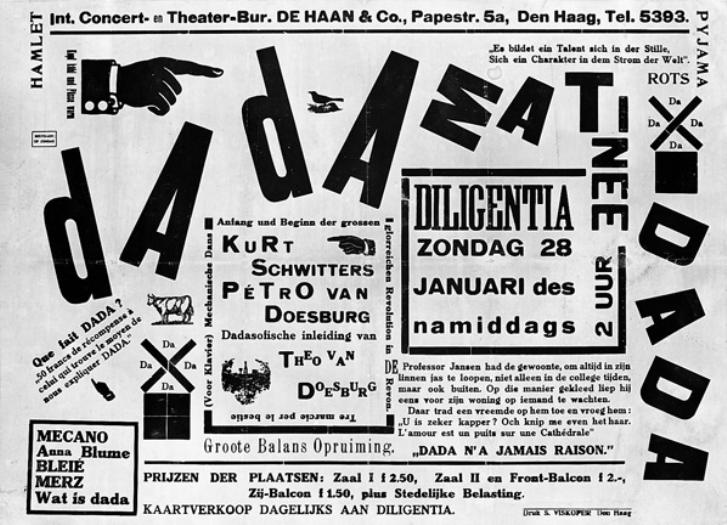
Prestation masquée de Theo VAN DOESBURG lors de Kleine Soirée DADA-MERZ, 1923



Tate Modern’s superb exhibition, Van Doesburg and the International Avant-Garde is the first major UK show to be devoted to the Dutch painter, architect and writer. This vast survey casts the spotlight on an artist frequently overshadowed by his co-founder of the De Stijl movement, Piet Mondrian. Theo van Doesburg made a distinctive contribution to the avant-garde in his plastic expression of the fourth dimension – time. Whereas Mondrian aspired towards total stability in his Neo-Plastic paintings, van Doesburg strove for dynamism in his use of the diagonal. He built bridges across the disciplines of painting, architecture, design, poetry and typography while re-inventing himself in multiple roles through a continual process of “becoming”. Not only was he the editor of the little magazine De Stijl, but also a Dada personality, a Bauhaus teacher and a proponent of Art Concret. Above all, he was a brilliant facilitator, as seen in the swirling mass of connections that unfolds in this kaleidoscopic exhibition.

The latest instalment in a Tate Modern series charting aspects of early Modernism via artistic exchange, the show results from a timely collaboration with the Stedelijk Museum De Lakenhal in Leiden, where van Doesburg began his career. In the first gallery, a mystical spiritualism shines out of the darkness in the pupil-like Cosmic Sun (1915), an ode to Kandinsky. Soon circles fall apart, dissecting the picture plane in homage to the father of cubism, Cézanne. The geometrical assemblage that floats across the canvas in Composition I (Still Life) (1916) marks a turning point in van Doesburg’s path towards abstraction. The next year he would transfigure a cow into an arrangement of blocks. His affiliation with Mondrian sparked his rapid progress: together with Bart van der Leck, Vilmos Huszár, Georges Vantongerloo and others, they launched De Stijl in 1917. The group’s journal would become a platform for constructing a modernist network across Europe, in quest of a Gesamtkunstwerk (total artwork) – it published a manifesto calling for progressive artists to “work for the formation of an international unity in Life, Art and Culture”.1 With the signing of the Armistice on 11 November 1918, they signalled the dawn of a new consciousness through a universal means of expression. The movement advocated the use of an elemental vocabulary of the straight line, the square and the rectangle in architecture, industrial design and urban planning, in order to effect societal change.

Van Doesburg made a key contribution to the development of De Stijl’s Neo-plasticist language through the method of abstraction he applied to his stained-glass windows. First he derived a motif from nature and then he broke up the image into multiple parts before re-integrating them into a whole design through patterns of repetition, reflection and rotation. The results appear in Stained-Glass Composition IV for the De Lange House, Alkmaar (1917) – a tripartite window coloured with a mosaic pattern, drawn from the study of a seated woman, calling to mind Bach’s fugues. The compositional method would open up a lively relationship with the environment, transforming van Doesburg’s outlook on architecture. Fascinated by motion, he assembled floating planes in space to express the fourth dimension of time. This creative approach emerges in the maze-like design for the tiled floor of De Vonk holiday home in Noordwijkerhout (c1917–18), a collaborative project with J.J.P. Oud. The chaotic dynamism of the pavement forces back the appearance of the interior walls, as though to “neutralise gravity”,2 in the architect’s own words. He theorised the art of building in the Principles of Neo-Plastic Art (1919), identifying an active element, mass, and a passive one, space. In a revised edition for the Bauhaus, where he propagated the “New Spirit” in 1921–22, he qualified “the elementary means of expression of architecture”, in terms of the positive elements of line, plane, volume, space and time, and negative elements: void and material.3 However, it was not only in architecture that he engaged with the concept of movement: he ran with the idea in his painting, graphic design, poetry and film.

Before leaving for Germany in 1920 van Doesburg produced a revolutionary expression of space-time, Composition XVIII in Three Parts. The artist intended for the pyramidal arrangement of paintings to compose a single whole, but its externalised centre met with Mondrian’s criticism. Yet the innovation succeeds in drawing the eye to the passage of a white cube, as it moves across the trio of canvases. Van Doesburg’s graphic design reflects this displacement: a layout of overlapping words enables a simultaneous reading of the poster for the international Cubist artists’ group show La Section d’Or (1920), where he exhibited Composition XVIII. Meanwhile, the cover design for the text of his lecture Classic, Baroque, Modern (1920) features a diagonal alignment of “Baroque”, which contravenes the static orthogonal grid associated with Neo-plasticism. As sole editor of the magazine De Stijl, van Doesburg engaged in a dialogue with Constructivist artists from abroad to communicate his dynamic vision of typography. For a special issue entitled Of 2 Squares (1922), based on the Suprematist children’s storybook charting the relationship between the fourth dimension, time, the three dimensions of the book and the two dimensions of the page, the Russian artist El Lissitzky produced a cover of soaring letters and shapes. This evoked a playful sense of freedom and a desire for flight, qualities that inspired van Doesburg to explore Futurism and Dadaism.

As editor of De Stijl, he published the seminal Call for Elementary Art, urging the artist to be “the interpreter of energies that shape the world’s elements”.4 In a bold move, he assumed the name of an experimental artist, I.K. Bonset, displaying a skill for deconstruction in the final statement of his first text: “SPACE/AM I”.5 The words mark a “splintering” of the self – a process that allowed him to escape traditional values and embrace the anarchic non-sense of Dada. In this vein, he published sound poems, set up a Dada convention at Weimar in 1922 and initiated a Dada tour in the Low Countries the next year. He improvised a Dada-Constructivist review Mécano, with whimsical texts and images scattered across primary-coloured paper, a counterpoint to the clean-cut austerity of De Stijl. The yellow issue featured paintings by Man Ray, articles by Tristan Tzara and poetry by Kurt Schwitters – who created an animated form of Dada, “Merz”. The blue issue was a showcase for the Hungarian artist László Moholy-Nagy, who wrote of his fascination at discovering the real identity of I.K. Bonset in Weimar. True to form, van Doesburg staged a surprising rapprochement between the Dadaists and Constructivists. “Life is an extraordinary invention,”6 he said.

Van Doesburg inspired cross-disciplinary practice in the Zurich Dadaist circle, which altered the direction of Neo-plasticism. The fusion of scroll paintings modelled on the Japanese makimono format and the syntax of music was a catalyst for experimentation. Viking Eggeling's Diagonal Symphony (1920) and Hans Richter’s Rhythmus 23 (1923) reveal sequences of colours that hold the potential to create the kinetic movement of film. But van Doesburg’s abstract language would soon take a new turn. From 1924 to 1927, he adopted a fresh approach, resulting from his theory of Elementarism, his rediscovery of axonometric projections and his oblique compositions for the University Hall in Amsterdam. The diagonal grid now underpinned his aesthetic, signifying a spatio-temporal tension in the monochromatic Counter-Composition VI (1925). When coloured by dissonant tones, his grids resonate with chords of energy, as in his mural scheme for the Café Aubette’s cinema-dance hall in Strasbourg (1926–27), devised in collaboration with Dadaists Sophie Taeuber and Hans Arp. Nearby in the gallery is the wooden furniture of Gerrit Rietveld, whose eloquence inspired van Doesburg to make the “unenclosed spatial relationship” the rule of “architecture as the synthesis of Neo-plasticism”.7 Rietveld’s Red-blue chair (1923) is among the iconic objects that populate the exhibition, weaving a rich context for understanding De Stijl’s human-made order.

Later, when living in Paris, van Doesburg created freeze-frame imagery: he achieved the illusion of a continuous state of motion by curtailing shapes at the canvas edge of Simultaneous Counter-Composition (1930). He re-evaluated his aesthetic in The Basis of Concrete Art, hinting at the manifesto’s radical nature with his suggestion of infinity in Arithmetic Composition (1929–30). Yet after his untimely death in 1931, he was remembered for his ability to gather the art world in a moment, under the diagonal sign. De Stijl contributors published a memorial issue with van Doesburg’s name emblazoned diagonally across the cover, rising in an upward trajectory. It is telling that a month before he died he wrote of a desire for rest and a hope to create the “style of the whole man”.8 For to recognise van Doesburg’s legacy is not only to appreciate his universal approach; it is to glimpse his singularity, as an artist who amused with his Dadaist act, and as an architect of lightness, who designed floating planes of time. With more than 400 objects and an illustrated catalogue featuring essays on multiple aspects of his life, this Tate Modern exhibition is the place to encounter new dimensions of Modernism.

References

1. Van Doesburg & the International Avant-Garde: Constructing a New World, edited by Gladys Fabre and Doris Wintgens Hötte, Tate Publishing, London, 2009: 11.

2. Ibid: 47.

3. Ibid: 37.

4. Ibid: 29.

5. Ibid: 70.

6. Ibid: 34.

7. Ibid: 43.

8. Ibid: 66.

Nicola HOMER. « Van Doesburg and the International Avant-Garde : Constructing a New World » (Tate Modern, London, 4 February–16 May 2010)
http://www.studio-international.co.uk/reports/van-doesburg-2010.asp
http://designhistorymashup.blogspot.com/2008/04/theo-van-doesburg.html

vendredi 23 septembre 2011

Fesival DADA Paris


FESTIVAL DADA PARIS 1920-23
(LTMCD 2513) £10

Un CD inédit émanant du répertoire pour piano executé pendant deux événements historiques à Paris, le Festival Dada du 26 mai 1920, et la funeste Soirée du Coeur à Barbe du 6 juillet 1923, spectacle interrompu par la confrontation violente entre le groupe dada de Tristan Tzara et la bande des surréalistes d'André Breton.

La musique de cet événement de 1920 comprend deux morceaux par Georges Ribemont-Dessaignes et La Nourrice américaine de Francis Picabia, décrite comme "trois notes répétées jusqu'à l'infinité". Parmi les autres sélections de cette soirée turbulente se trouvent deux fox-trots de Georges Auric et Darius Milhaud (membres du célèbre Groupe des Six), Trois Morceaux en forme de poire d'Erik Satie et Trois pièces faciles d'Igor Stravinsky. Le CD comprend aussi la piècette Le Piège de Méduse de Satie, Drie composities voor Klavier du dadaîste/surréaliste belge E.L.T. Mesens, et une interprétation pour piano de l'Erratum musical de Marcel Duchamp (1913).

Pour terminer, le CD présente un enregistrement historique (1925) de Stravinsky par Marcelle Meyer, pianiste renommée qui a participé à la soirée de 1923. Ce CD contient les tout premiers enregistrements des compositions de Ribemont-Dessaignes, Picabia and Mesens, raretés musicales dadaîstes. Le pianiste virtuose hollandais Peter Beijersbergen van Henegouwen joue la musique (qu'il a su dénicher). James Hayward a écrit la brochure contenant des notes détaillées sur la période. Pour lire cette brochure en ligne cliquez ici.

Sommaire :

Erik SATIE : Trois morceaux en forme de poire
Darius MILHAUD : Caramel Mou (shimmy)
Georges AURIC : Adieu, New York (fox-trot)
Igor STRAVINSKY : Trois pièces faciles à quatre mains
Georges RIBEMONT DESSAIGNES : Le Nombril interlope
Francis PICABIA : La nourrice américaine (rapide)
Georges RIBEMONT DESSAIGNE : Pas de la chicorée frisée
Erik SATIE : Le Piège de la Méduse
E.L.T. MESENS : Drie composities voor Klavier
Marcel DUCHAMP : Erratum musical
Francis PICABIA : La nourrice américaine (lent)
Igor STRAVINSKY : Rag-Time (1925 recording by Marcelle MEYER)
Le Pelican (fox-trot) (enregistrement sur cire)
ISBN 978-1-906310-07-3
Si vous désirez commander les CD suivants au prix de £10 chacun contactez : James NICE
jnice@ltmpub.freeserve.co.uk

http://www.dadart.com/dadaisme/dada/016-dada-cd.html


samedi 17 septembre 2011

NELLY VAN DOESBURG


Florence HENRI. Portrait photographique de Nelly van Doesburg, 1928


GÉNÉRALITÉS


In the years before World War I, Europe appeared to be losing its hold on reality. Einstein’s universe seemed like science fiction, Freud’s theories put reason in the grip of the unconscious and Marx’s Communism aimed to turn society upside down, with the proletariat on top. The arts were also coming unglued. Schoenberg’s music was atonal, Mallarmé’s poems scrambled syntax and scattered words across the page and Picasso’s Cubism made a hash of human anatomy.
And even more radical ideas were afoot. Anarchists and nihilists inhabited the political fringe, and a new breed of artist was starting to attack the very concept of art itself. In Paris, after trying his hand at Impressionism and Cubism, Marcel Duchamp rejected all painting because it was made for the eye, not the mind.
“In 1913 I had the happy idea to fasten a bicycle wheel to a kitchen stool and watch it turn,” he later wrote, describing the construction he called Bicycle Wheel, a precursor of both kinetic and conceptual art. In 1916, German writer Hugo Ball, who had taken refuge from the war in neutral Switzerland, reflected on the state of contemporary art: “The image of the human form is gradually disappearing from the painting of these times and all objects appear only in fragments....The next step is for poetry to decide to do away with language.”
That same year, Ball recited just such a poem on the stage of the Cabaret Voltaire in Zurich, a nightspot (named for the 18th-century French philosopher and satirist) that he, Emmy Hennings (a singer and poet he would later marry) and a few expatriate pals had opened as a gathering place for artists and writers. The poem began: “gadji beri bimba / glandridi lauli lonni cadori....” It was utter nonsense, of course, aimed at a public that seemed all too complacent about a senseless war. Politicians of all stripes had proclaimed the war a noble cause—whether it was to defend Germany’s high culture, France’s Enlightenment or Britain’s empire. Ball wanted to shock anyone, he wrote, who regarded “all this civilized carnage as a triumph of European intelligence.” One Cabaret Voltaire performer, Romanian artist Tristan Tzara, described its nightly shows as “explosions of elective imbecility.”
This new, irrational art movement would be named Dada. It got its name, according to Richard Huelsenbeck, a German artist living in Zurich, when he and Ball came upon the word in a French-German dictionary. To Ball, it fit. “Dada is ‘yes, yes’ in Rumanian, ‘rocking horse’ and ‘hobby horse’ in French,” he noted in his diary. “For Germans it is a sign of foolish naiveté, joy in procreation, and preoccupation with the baby carriage.” Tzara, who later claimed that he had coined the term, quickly used it on posters, put out the first Dada journal and wrote one of the first of many Dada manifestoes, few of which, appropriately enough, made much sense.
But the absurdist outlook spread like a pandemic—Tzara called Dada “a virgin microbe”—and there were outbreaks from Berlin to Paris, New York and even Tokyo. And for all its zaniness, the movement would prove to be one of the most influential in modern art, foreshadowing abstract and conceptual art, performance art, op, pop and installation art. But Dada would die out in less than a decade and has not had the kind of major museum retrospective it deserves, until now.
The Dada exhibition at the National Gallery of Art in Washington, D.C. (on view through May 14) presents some 400 paintings, sculptures, photographs, collages, prints, and film and sound recordings by more than 40 artists. The show, which moves to New York’s Museum of Modern Art (June 18 through September 11), is a variation on an even larger exhibition that opened at the Pompidou Center in Paris in the fall of 2005. In an effort to make Dada easier to understand, the American curators, Leah Dickerman, of the National Gallery, and Anne Umland, of MoMA, have organized it around the cities where the movement flourished—Zurich, Berlin, Hanover, Cologne, New York and Paris.
Dickerman traces Dada’s origins to the Great War (1914-18), which left 10 million dead and some 20 million wounded. “For many intellectuals,” she writes in the National Gallery catalog, “World War I produced a collapse of confidence in the rhetoric—if not the principles—of the culture of rationality that had prevailed in Europe since the Enlightenment.” She goes on to quote Freud, who wrote that no event “confused so many of the clearest intelligences, or so thoroughly debased what is highest.” Dada embraced and parodied that confusion. “Dada wished to replace the logical nonsense of the men of today with an illogical nonsense,” wrote Gabrielle Buffet-Picabia, whose artist husband, Francis Picabia, once tacked a stuffed monkey to a board and called it a portrait of Cézanne.
“Total pandemonium,” wrote Hans Arp, a young Alsatian sculptor in Zurich, of the goings-on at the “gaudy, motley, overcrowded” Cabaret Voltaire. “Tzara is wiggling his behind like the belly of an Oriental dancer. Janco is playing an invisible violin and bowing and scraping. Madame Hennings, with a Madonna face, is doing the splits. Huelsenbeck is banging away nonstop on the great drum, with Ball accompanying him on the piano, pale as a chalky ghost.”
These antics struck the Dada crowd as no more absurd than the war itself. A swift German offensive in April 1917 left 120,000 French dead just 150 miles from Paris, and one village witnessed a band of French infantrymen (sent as reinforcements) baa-ing like lambs led to slaughter, in futile protest, as they were marched to the front. “Without World War I there is no Dada,” says Laurent Le Bon, the curator of the Pompidou Center’s show. “But there’s a French saying, ‘Dada explains the war more than the war explains Dada.’”
Two of Germany’s military leaders had dubbed the war “Materialschlacht,” or “the battle of equipment.” But the dadas, as they called themselves, begged to differ. “The war is based on a crass error,” Hugo Ball wrote in his diary on June 26, 1915. “Men have been mistaken for machines.”
It was not only the war but the impact of modern media and the emerging industrial age of science and technology that provoked the Dada artists. As Arp once complained, “Today’s representative of man is only a tiny button on a giant senseless machine.” The dadas mocked that dehumanization with elaborate pseudodiagrams—chockablock with gears, pulleys, dials, wheels, levers, pistons and clockworks—that explained nothing. The typographer’s symbol of a pointing hand appeared frequently in Dada art and became an emblem for the movement—making a pointless gesture. Arp created abstract compositions from cutout paper shapes, which he dropped randomly onto a background and glued down where they fell. He argued for this kind of chance abstraction as a way to rid art of any subjectivity. Duchamp found a different way to make his art impersonal—drawing like a mechanical engineer rather than an artist. He preferred mechanical drawing, he said, because “it’s outside all pictorial convention.”
When Dadaists did choose to represent the human form, it was often mutilated or made to look manufactured or mechanical. The multitude of severely crippled veterans and the growth of a prosthetics industry, says curator Leah Dickerman, “struck contemporaries as creating a race of half-mechanical men.” Berlin artist Raoul Hausmann fabricated a Dada icon out of a wig-maker’s dummy and various oddments—a crocodile-skin wallet, a ruler, the mechanism of a pocket watch—and titled it Mechanical Head (The Spirit of Our Age). Two other Berlin artists, George Grosz and John Heartfield, turned a life-size tailor’s dummy into a sculpture by adding a revolver, a doorbell, a knife and fork and a German Army Iron Cross; they gave it a working light bulb for a head, a pair of dentures at the crotch and a lamp stand as an artificial leg.
Duchamp traced the roots of Dada’s farcical spirit back to the fifth-century b.c. Greek satirical playwright Aristophanes, says the Pompidou Center’s Le Bon. A more immediate source, however, was the absurdist French playwright Alfred Jarry, whose 1895 farce Ubu Roi (King Ubu) introduced “’Pataphysics”—“the science of imaginary solutions.” It was the kind of science that Dada applauded. Erik Satie, an avant-garde composer who collaborated with Picasso on stage productions and took part in Dada soirees, claimed that his sound collages—an orchestral suite with passages for piano and siren, for example—were “dominated by scientific thought.”
Duchamp probably had the most success turning the tools of science into art. Born near Rouen in 1887, he had grown up in a bourgeois family that encouraged art—two older brothers and his younger sister also became artists. His early paintings were influenced by Manet, Matisse and Picasso, but his Nude Descending a Staircase no. 2 (1912)—inspired by early stop-action photographic studies of motion—was entirely his own. In the painting, the female nude figure seems to take on the anatomy of a machine.
Rejected by the jury for the Salon des Independants of 1912 in Paris, the painting created a sensation in America when it was exhibited in New York City at the 1913 Armory Show (the country’s first large-scale international exposition of modern art). Cartoon parodies of the work appeared in local papers, and one critic mocked it as “an explosion in a shingle factory.” The Nude was snapped up (for $240) by a collector, as were three other Duchamps. Two years after the show, Duchamp and Picabia, whose paintings had also sold at the Armory Show, traded Paris for Manhattan. Duchamp filled his studio on West 67th Street with store-bought objects that he called “readymades”—a snow shovel, a hatrack, a metal dog comb. Explaining his selections some years later, he said: “You have to approach something with an indifference, as if you had no aesthetic emotion. The choice of readymades is always based on visual indifference and, at the same time, on the total absence of good or bad taste.” Duchamp didn’t exhibit his readymades at first, but he saw in them yet another way to undermine conventional ideas about art.
In 1917, he bought a porcelain urinal at a Fifth Avenue plumbing supply shop, titled it Fountain, signed it R. Mutt and submitted it to a Society of Independent Artists exhibition in New York City. Some of the show’s organizers were aghast (“the poor fellows couldn’t sleep for three days,” Duchamp later recalled), and the piece was rejected. Duchamp resigned as chairman of the exhibition committee in support of Mutt and published a defense of the work. The ensuing publicity helped make Fountain one of Dada’s most notorious symbols, along with the print of Leonardo da Vinci’s Mona Lisa the following year, to which Duchamp had added a penciled mustache and goatee.
Parodying the scientific method, Duchamp made voluminous notes, diagrams and studies for his most enigmatic work, The Bride Stripped Bare by Her Bachelors, Even (or The Large Glass)—a nine-foot-tall assemblage of metal foil, wires, oil, varnish and dust, sandwiched between glass panels. Art historian Michael Taylor describes the work as “a complex allegory of frustrated desire in which the nine uniformed bachelors in the lower panel are perpetually thwarted from copulating with the wasplike, biomechanical bride above.”
Duchamp’s irreverence toward science was shared by two of his New York companions, Picabia and a young American photographer, Man Ray. Picabia could draw with the precision of a commercial artist, making his nonsensical diagrams seem particularly convincing. While Duchamp built machines with spinning disks that created surprising spiral patterns, Picabia covered canvases with disorienting stripes and concentric circles—an early form of optical experimentation in modern painting. Man Ray, whose photographs documented Duchamp’s optical machines, put his own stamp on photography by manipulating images in the darkroom to create illusions on film.
After the war ended in 1918, Dada disturbed the peace in Berlin, Cologne, Hanover and Paris. In Berlin, artist Hannah Höch gave an ironic domestic touch to Dada with collages that incorporated sewing patterns, cut-up photographs taken from fashion magazines and images of a German military and industrial society in ruins.
In Cologne, in 1920, German artist Max Ernst and a band of local dadas, excluded from a museum exhibition, organized their own—“Dada Early Spring”—in the courtyard of a pub. Out past the men’s room, a girl wearing a “communion dress recited lewd poetry, thus assaulting both the sanctity of high art and of religion,” art historian Sabine Kriebel notes in the current exhibition’s catalog. In the courtyard, “viewers were encouraged to destroy an Ernst sculpture, to which he had attached a hatchet.” The Cologne police shut down the show, charging the artists with obscenity for a display of nudity. But the charge was dropped when the obscenity turned out to be a print of a 1504 engraving by Albrecht Dürer titled Adam and Eve, which Ernst had incorporated into one of his sculptures.
In Hanover, artist Kurt Schwitters began making art out of the detritus of postwar Germany. “Out of parsimony I took whatever I found to do this,” he wrote of the trash he picked up off the streets and turned into collages and sculptural assemblages. “One can even shout with refuse, and this is what I did, nailing and gluing it together.” Born the same year as Duchamp—1887—Schwitters had trained as a traditional painter and spent the war years as a mechanical draftsman in a local ironworks. At the war’s end, however, he discovered the Dadaist movement, though he rejected the name Dada and came up with his own, Merz, a word that he cut out of an advertising poster for Hanover’s Kommerz-und Privatbank (a commercial bank) and glued into a collage. As the National Gallery’s Dickerman points out, the word invoked not only money but also the German word for pain, Schmerz, and the French word for excrement, merde. “A little money, a little pain, a little sh-t,” she says, “are the essence of Schwitters’ art.” The free-form construction built out of found objects and geometric forms that the artist called the Merzbau began as a couple of three-dimensional collages, or assemblages, and grew until his house had become a construction site of columns, niches and grottoes. In time, the sculpture actually broke through the building’s roof and outer walls; he was still working on it when he was forced to flee Germany by the Nazis’ rise to power. In the end, the work was destroyed by Allied bombers during World War II.
Dada’s last hurrah was sounded in Paris in the early 1920s, when Tzara, Ernst, Duchamp and other Dada pioneers took part in a series of exhibitions of provocative art, nude performances, rowdy stage productions and incomprehensible manifestoes. But the movement was falling apart. The French critic and poet André Breton issued his own Dada manifestoes, but fell to feuding with Tzara, as Picabia, fed up with all the infighting, fled the scene. By the early 1920s Breton was already hatching the next great avant-garde idea, Surrealism. “Dada,” he gloated, “very fortunately, is no longer an issue and its funeral, about May 1921, caused no rioting.”
But Dada, which wasn’t quite dead yet, would soon leap from the grave. Arp’s abstractions, Schwitters’ constructions, Picabia’s targets and stripes and Duchamp’s readymades were soon turning up in the work of major 20th-century artists and art movements. From Stuart Davis’ abstractions to Andy Warhol’s Pop Art, from Jasper Johns’ targets and flags to Robert Rauschenberg’s collages and combines—almost anywhere you look in modern and contemporary art, Dada did it first. Even Breton, who died in 1966, recanted his disdain for Dada. “Fundamentally, since Dada,” he wrote, not long before his death, “we have done nothing.”
Paul TRACHTMAN. « DADA. The Irreverent, Rowdy Revolution Set the Trajectory of 20th-century Art », Smithsonian Magazine, May 2006
http://www.smithsonianmag.com/arts-culture/dada.html

vendredi 16 septembre 2011

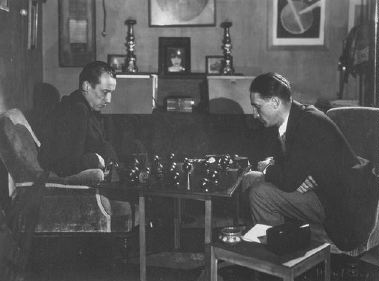
Marcel DUCHAMP et l'art des échecs (II)

MAN RAY, photographie de Raoul DE ROUSSY DE SALES et Marcel DUCHAMP jouant aux échecs, Paris, 1924
http://chessgames.com/player/marcel_duchamp.html
http://sites.google.com/site/caroluschess/famous-people/artists/marcel-duchamp

DADAS de Berlin


Wieland HERZFELDE, Eva GROSZ, George GROSZ, Rudolf SCHLICHTER et John HEARTFIELD, Berlin, 1922