mardi 23 février 2010

MARCEL DUCHAMP (I) : READY-MADE 1913-1921

Marcel DUCHAMP. Roue de bicyclette, Roue métallique montée sur un tabouret en bois peint, Neuilly, 1913. hauteur ; 128,5, New York, The Museum of Modern Art

« La Roue de Bicyclette est mon premier readymade, à tel point que ça ne s'appelait même pas un readymade. Voir cette roue tourner était très apaisant, très réconfortant, c'était une ouverture sur autre chose que la vie quotidienne. J'aimais l'idée d'avoir une roue de bicyclette dans mon atelier. J'aimais la regarder comme j'aime regarder le mouvement d'un feu de cheminée. »

Marcel DUCHAMP, cité dans André GERVAIS. « Roue de bicyclette, épitexte, texte et intertextes », Cahiers du MNAM n° 30

***

La Roue de bicyclette, premier ready-made réalisé par Marcel Duchamp en 1913, déconcerte d'abord par son caractère surréaliste avant la lettre. Aussi étrange qu'elle paraisse, cette association hétéroclite de deux objets ordinaires qui ne doit plus rien au savoir-faire traditionnel de l'artiste, ne résulte cependant pas d'un choix arbitraire. Sa conception radicale répond à un contexte que dépeint parfaitement une remarque qu'adressa Duchamp au sculpteur Constantin Brancusi alors qu'ils visitaient ensemble, cette même année 1913, le salon de la Locomotion aérienne : « C'est fini la peinture. Qui peut faire mieux que cette hélice ? ». Tout est donc « déjà fait » - ready made - et l'œuvre de Duchamp ne modifie l'objet industriel (la roue) que pour en manifester la perfection esthétique. Car ainsi disposée à l'envers sur un tabouret de dessinateur qui s'apparente à un piédestal fabriqué en série, la roue devient aussi inutile que toute autre sculpture digne de ce nom. Elle n'en conserve pas moins sa spécificité : il est possible de la mettre en mouvement et d'ajouter à sa rotation celle de la fourche pivotant sur son axe. À condition que notre regard y consente, le ready-made se voit élevé au rang de sculpture, éventuellement cinétique, avec une ironie qui n'a cessé depuis de perturber nos conventions culturelles.

Hervé VANEL. « Roue de bicyclette », Encyclopaedia Universalis
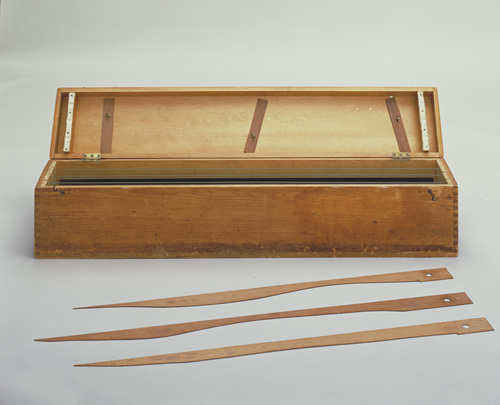
Marcel DUCHAMP. Trois stoppages étalon et leurs trois règles à tracer, 1913-1914. Trois fils fixés sur des bandes de toile collées sur verre, rangés dans une boîte de jeu de croquet.
New York, Museum of Modern Art


Marcel DUCHAMP. Trois stoppages étalon et leurs trois règles à tracer, 1913-1914. Trois fils fixés sur des bandes de toile collées sur verre. New York, Museum of Modern Art


Duchamp répète trois fois l'expérience suivante : il laisse tomber horizontalement un fil de 1m de longueur depuis 1m de hauteur, laissant le fil se déformer à son gré. Il collecte ces trois devenus en les fixant avec du vernis, chacun sur une bande de toile elle-même collée sur une plaque de verre. Puis il reporte ces nouvelles lignes par découpe sur trois mètres ordinaires en bois et range l'ensemble dans une boîte de jeu de croquet.


« Mes trois stoppages-étalon sont donnés par trois expériences, et la forme est un peu différente pour chacune. Je garde la ligne et j'ai un mètre déformé. C'est un mètre en conserve, si vous voulez, c'est du hasard en conserve. » (Marcel DUCHAMP. Entretiens)
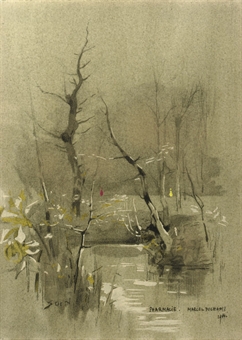
Marcel DUCHAMP. Pharmacie. Rouen, janvier 1914, 26,2 X 19,3

Marcel DUCHAMP. Porte-bouteilles, Paris, printemps 1914. Porte-bouteilles en fer galvanisé (environ 64 × 42 cm), choisi en 1914 au Bazar de l'Hôtel de Ville (BHV) de Paris, « sur la base d'une pure indifférence visuelle ». L'artiste n'intervenant que pour choisir et intituler l'objet, celui-ci prend le nom de Porte-bouteilles et plus tard Séchoir à bouteilles ou Hérisson

Marcel DUCHAMP. In advance of a broken arm, New York, novembre 1915
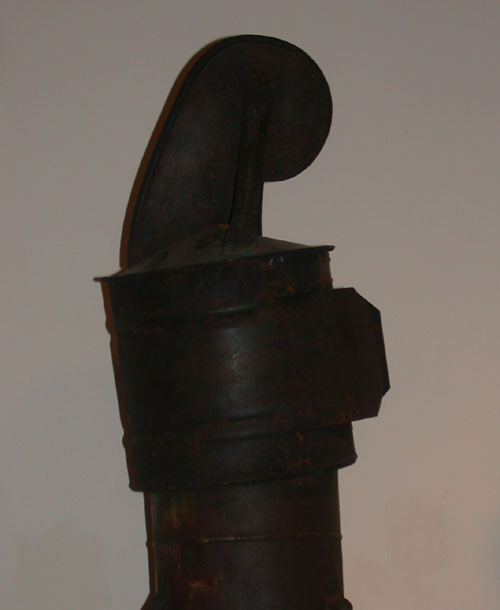
Marcel DUCHAMP. Pulled at 4 pins, New York, 1915
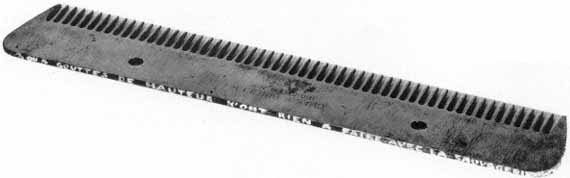


Marcel DUCHAMP. Peigne, New York, 17 février 1916, 11h00 A. M. Peigne en acier : sur ce peigne sont marquées la date et l'heure à laquelle il choisi ce ready-made
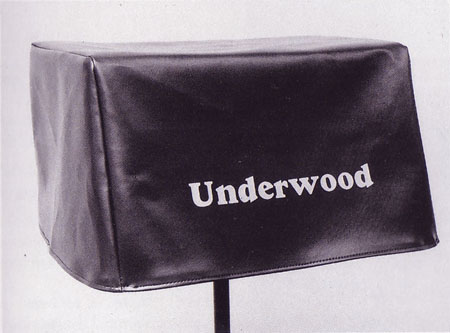

ap.over-blog.org.over-blog.org/article-192173...


Marcel DUCHAMP. Pliant…de Voyage - Traveler’s folding item, New York, 1916

Marcel DUCHAMP. Readymade aidé (À bruit secret) [With Hidden Noise], New York, Pâques 1916. 12.9 x 13 x 11.4. Philadelphie, The Philadelphia Museum of Art

Marcel DUCHAMP (Richard MUTT). Fontaine, New York, avril 1917, porcelaine, hauteur : 33,5. Photographie d'Alfred STIEGLITZ (The Blind Man)
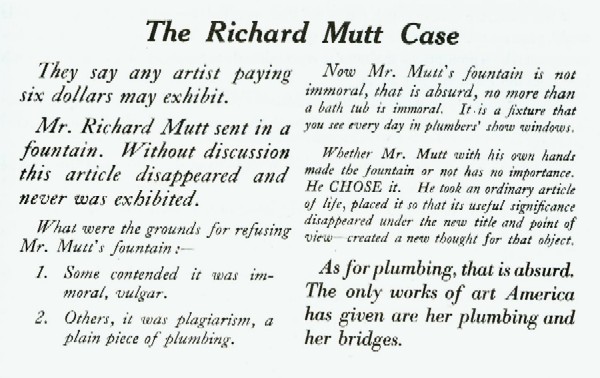

« The Richard Mutt Case », The Blind Man (éds : Marcel DUCHAMP, Henri-Pierre ROCHÉ & Beatrice WOOD), New York, 1917

En 1913 j'eus l'heureuse idée de fixer une roue de bicyclette sur un tabouret de cuisine et de la regarder tourner.

Quelques mois plus tard j'ai acheté une reproduction bon marché d'un paysage de soir d'hiver, que j'appelai « Pharmacie » après y avoir ajouté deux petites touches, l'une rouge et l'autre jaune, sur l'horizon.

À New York en 1915 j'achetai dans une quincaillerie une pelle à neige sur laquelle j'écrivis « En prévision du bras cassé » (In advance of the broken arm).

C'est vers cette époque que le mot « ready-made » me vint à l'esprit pour désigner cette forme de manifestation.

Il est un point que je veux établir très clairement, c'est que le choix de ces ready-mades ne me fut jamais dicté par quelque délectation esthétique. Ce choix était fondé sur une réaction d'indifférence visuelle, assortie au même moment à une absence totale de bon ou de mauvais goût… en fait une anesthésie complète.

Une caractéristique importante : la courte phrase qu'à l'occasion j'inscrivais sur le ready-made.

Cette phrase, au lieu de décrire l'objet comme l'aurait fait un titre, était destinée à emporter l'esprit du spectateur vers d'autres régions plus verbales.

Quelques fois j'ajoutais un détail graphique de présentation : j'appelais cela pour satisfaire mon penchant pour les allitérations, « un ready-made aidé » (ready-made aided).

Une autre fois, voulant souligner l'antinomie fondamentale qui existe entre l'art et les ready-mades, j'imaginais un « ready-made réciproque » (reciprocal ready-made) : se servir d'un Rembrandt comme table à repasser !

Très tôt je me rendis compte du danger qu'il pouvait y avoir à resservir sans discrimination cette forme d'expression et je décidai de limiter la production des ready-mades à un petit nombre chaque année. Je m'avisai à cette époque que, pour le spectateur plus encore que pour l'artiste, l'art est une drogue à accoutumance et je voulais protéger mes ready-mades contre une contamination de ce genre.

Un autre aspect du ready-made est qu'il n'a rien d'unique… La réplique d'un ready-made transmet le même message ; en fait presque tous les ready-mades existant aujourd'hui ne sont pas des originaux au sens reçu du terme.

Une dernière remarque pour conclure ce discours d'égomaniaque :

Comme les tubes de peintures utilisés par l'artiste sont des produits manufacturés et tout faits, nous devons conclure que toutes les toiles du monde sont des ready-mades aidés et des travaux d'assemblage.

Marcel DUCHAMP, « À propos des Ready-mades », discours au Musée d'Art moderne de New York, 1961, dans le cadre de l'exposition Art of assemblage. (Reproduit dans Duchamp du signe, Paris, Flammarion, 1994, pp. 191-192)

***

Ce Néo-Dada qui se nomme maintenant nouveau Réalisme, Pop Art, Assemblage, etc., est une distraction à bon marché qui vit de ce que DADA a fait. Lorsque j'ai découvert les reay-made, j'espérais décourager le carnaval d'esthétisme. Mais les néo-dadaïstes utilisent les ready-made pour leur découvrir une valeur esthétique. Je leur ai jeté le porte-bouteilles et l'urinoir à la tête comme une provocation et voilà qu'ils en admirent la beauté esthétique.

Marcel DUCHAMP, « Lettre à Hans RICHTER », le 10 novembre 1962
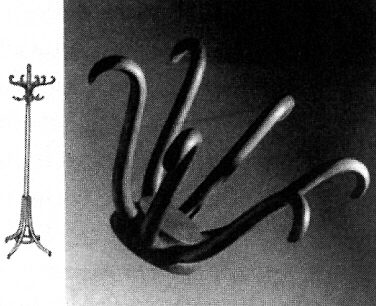

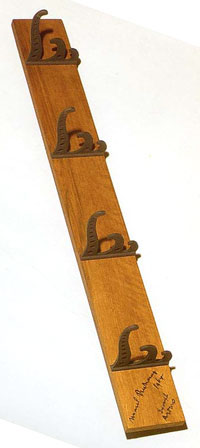
Marcel DUCHAMP. Porte-chapeau, New York, 1917

Marcel DUCHAMP. Porte-chapeau, New York, 1917


Marcel DUCHAMP. Trébuchet, New York, 1917


Marcel DUCHAMP. Sculpture de voyage, Buenos Aires, 1918, disparue
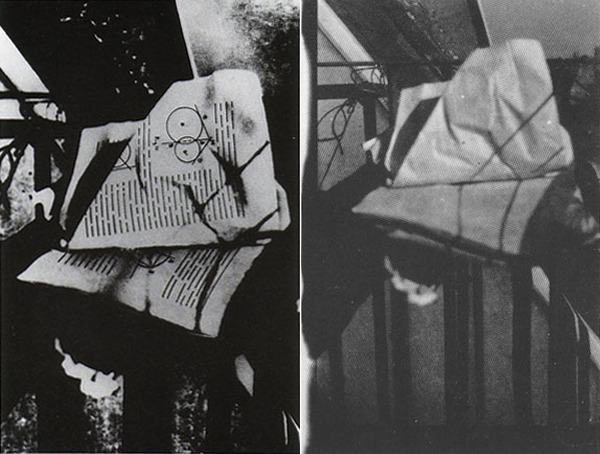


Marcel DUCHAMP et Suzanne DUCHAMP. Ready-made malheureux,
Buenos Aires / Paris, avril 1919

Marcel Duchamp est à Buenos Aires depuis quelques semaines quand une lettre de sa soeur Suzanne lui apprend qu'elle épouse en avril 1919 le peintre Jean Crotti. Ne pouvant faire le voyage, Marcel envoie par courrier ses instructions pour un cadeau de mariage : « C'était un précis de géométrie qu'il lui fallait attacher avec des ficelles sur le balcon de son appartement de la rue de La Condamine; le vent devait compulser le livre, choisir lui-même les problèmes, effeuiller les pages et les déchirer. Suzanne en a fait un petit tableau : Readymade malheureux de Marcel. C'est tout ce qu'il en reste puisque le vent l'a déchiré. Ça m'avait amusé d'introduire l'idée d'heureux et de malheureux dans les readymades, et puis la pluie, le vent, les pages qui volent, c'est amusant comme idée...»

Marcel DUCHAMP. Entretiens


Marcel DUCHAMP. LHOOQ, octobre 1919 (publié dans 391, numéro 12, Paris, 1920)


Marcel DUCHAMP & Francis PICABIA. LHOOQ Tableau Dada par Marcel Duchamp, moustache par Picabia, barbiche par Marcel Duchamp. 1919-1942

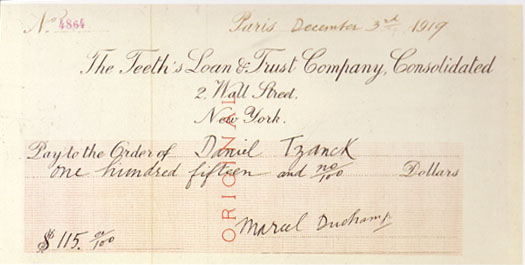
Marcel DUCHAMP. Chèque Tzanck, Paris, 3 décembre 1919. Encre sur papier, 21 X 38,
 collection particulière

Marcel DUCHAMP. 50cc d'air de Paris, paris, décembre 1919


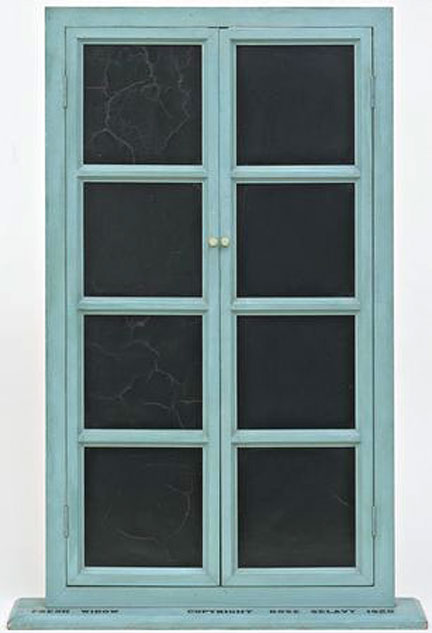
Marcel DUCHAMP. Fresh Widow, copyright Rrose Sélavy, New York, hiver 1920


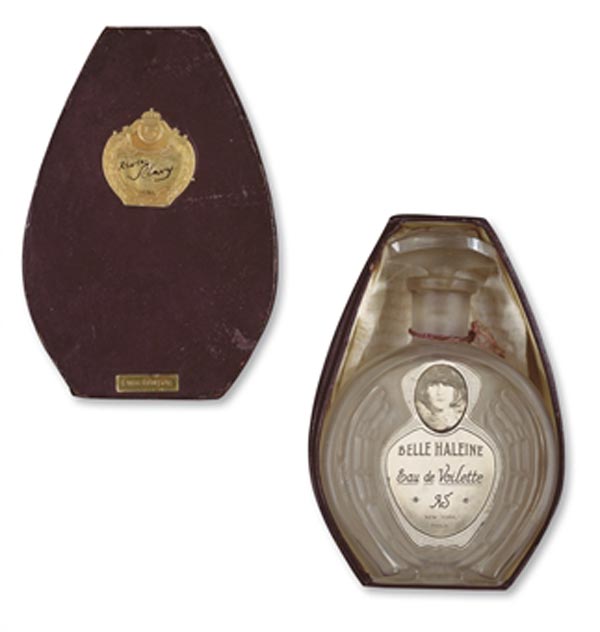
Marcel DUCHAMP. Belle Haleine - Eau de Voilette, Ready-made rectifié, bouteille de parfum avec étiquette, étui en carton, 16,5 X11, New York, avril 1921


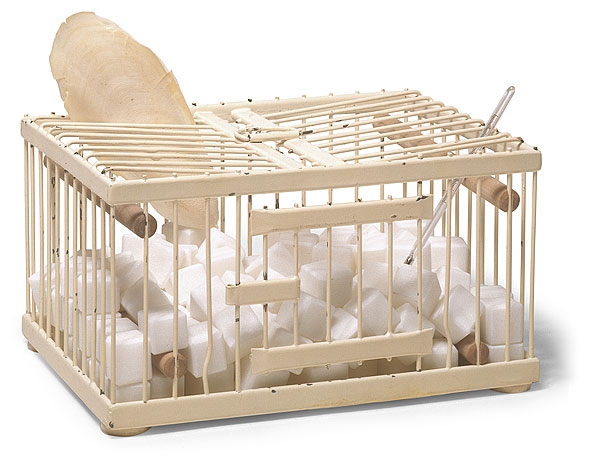
Marcel DUCHAMP. Why not sneeze Rrose Sélavy ? New York, juin 1921, 12.4 X 22.2 X 16.2. Ready-made assisté : cage à oiseaux, cubes de marbre, thermomètre et os de seiche National Philadelphie, The Philadelphia Museum of Art

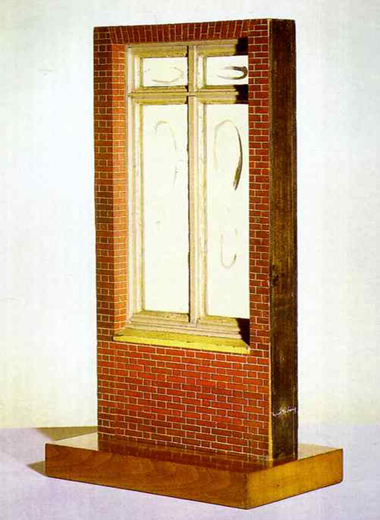
Marcel DUCHAMP. La Bagarre d'Austerlitz, par Rrose Sélavy, Fenêtre miniature : huile sur bois et verre. Paris, novembre 1921, 62.8 X 28.7 X 6.3, Stuttgart, Staatsgalerie


Hector Obalk. The Unfindable Readymade : http://www.toutfait.com/issues/issue_2/Articles/obalk.html

Thomas Girst. (Ab)Using Marcel Duchamp: The Concept of the Readymade in Post-War and Contemporary American Art :

jeudi 18 février 2010

DADA-BERLIN : INTERNATIONAL DADA-MESSE, 1920 (II)


RAOUL HAUSMANN : L'ESPRIT DE NOTRE TEMPS


GEORGE GROSZ (III)

George GROSZ. DADA-Bild. Photomontage et encre de Chine, 1919-1920, 37 X 30, Zurich, Kunsthaus


George GROSZ. Remember Uncle August, the Unhappy Inventor. Ein Opfer der Gesellschaft, Photomontage, 1919

George GROSZ. "Der Strafling" Monteur John Heartfield nach Franz Jungs, Versuch ihn auf die Beine zu stellen (Le Détenu ; le monteur John Heartfield, après la tentative de Franz Jung de le remettre sur pied), Photomontage, aquarelle et dessin, 1920, 42 X 30,5, New York, the Museum of Modern Art

JOHN HEARTFIELD (I)

John HEARTFIELD (1891-1968)
HEARTFIELD : HELMUT HERZFELDE dit JOHN (1891-1968). Peintre allemand. Attiré très tôt par le marxisme, Heartfied, qui vit à Berlin depuis 1913, est influencé par George Grosz ; celui-ci l’introduit dans le groupe dadaïste en 1918. Avec Grosz, Heartfield exécutera quelques photomontages de style futuriste (Dadamerika). En juin 1920, il participe à la Foire internationale dada (avec Raoul Hausmann et Grosz). Peu après cette date, Heartfield crée ses premiers photomontages militants, spécialité pour laquelle il abandonnera bientôt la peinture. Son frère, Wieland Herzfelde, le fondateur des éditions Malik (qui n’avait pas " anglicisé " son nom), joua également un certain rôle dans le mouvement par ses audaces typographiques et lui consacra un livre important en 1971. Membre du Parti communiste allemand, Heartfield devint le principal auteur d’affiches " modernes " stigmatisant la montée du nazisme, tout en appliquant sa maîtrise dans le photomontage à des couvertures de revues, des jaquettes de livres, des décors de théâtre et de cinéma. Il est en particulier engagé en 1930 comme collaborateur du journal ouvrier Arbeiter Illustrierte Zeitung (A.I.Z.), dont il illustre de nombreuses couvertures de photomontages dont la violence fera dire à Louis Aragon que Heartfield " est le prototype et le modèle de l’artiste antifasciste ". En 1933, il se réfugie à Prague, puis en Angleterre de 1938 à 1949 ; il rentre, en 1950, en Allemagne de l’Est et s’installe jusqu’à sa mort à Berlin-Est, où il créera des affiches et des décors pour le Berliner Ensemble et pour le Deutsches Theater.
***
Helmut Herzfelde was born in Berlin, Germany on 19th June, 1891. His father was a socialist writer and his mother was a textile worker and trade union activist. As a result of their politics the family was forced to flee to Switzerland in 1896. After leaving school at fourteen Herzfelde worked for a bookseller in Wiesbadenl.
In 1907 he became an assistant to the painter, Hermann Bouffier, and two years later became a student at the School of Applied Arts in Munich.
In 1912 Herzefelde started work as a designer in Mannheim for a year before moving to Berlin to study under Ernst Neuman at the Arts and Crafts School.
During the First World War Herzefelde began contributing work to Die Neue Jugend, an arts journal published by his brother, Wieland Herzfelde. He was drafted into the infantry where he meets George Grosz. Herzefelde continued to contribute illustrations to Die Neue Jugend. While working for the journal Heartfield developed a new style of work that later became known as photomontage (the production of pictures by rearranging selected details of photographs to form a new and convincing unity). A pacifist and Marxist, Herzfelde, changed his name to John Heartfield in 1916 in protest against German nationalism.
After the war Heartfield joined the newly formed German Communist Party (KPD) and over the next fifteen years produces designs and posters for the organization. During this period artists such as George Grosz, Otto Dix, Max Ernst and Kurt Schwitters form the German Dada group. Some of these artists, including Ernst and Schwitters, were influenced by the work of Heartfield and developed his ideas on photomontage.
In 1923 Heartfield became editor of the satirical magazine, Der Knöppel. Heartfield also worked for the socialist magazine, A.I.Z., where he used photomontage to attack Adolf Hitler and his Nazi Party. Under threat of arrest, Heartfield was forced to leave Germany in 1938.
Heartfield moved to England where he produced photomontages for the Reynolds News, Picture Post and Penguin Books.
Heartfield returned to Germany in 1950 where he designed scenery and posters for the Berliner Ensemble and the Deutsches Theater in Berlin. In 1960 he became professor at the German Academy of Arts in Berlin.John Heartfield died in Berlin on 26th April, 1968
***

When John Heartfield and I invented photomontage in my South End studio at five o'clock on a May morning in 1916, neither of us had any inkling of its great possibilities, nor of the thorny yet successful road it was to take. As so often happens in life, we had stumbled across a vein of gold without knowing it.
George GROSZ interviewed by Erwin PISCATOR (1928)


George GROSZ & John HEARTFIELD. DADA-Merica, Photomontage, 1920

mardi 16 février 2010

OBERDADA BAADER

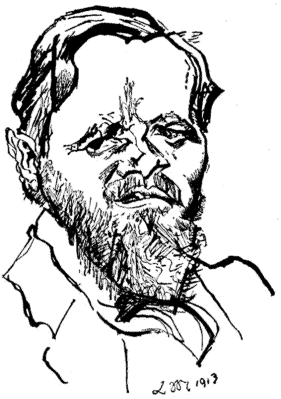
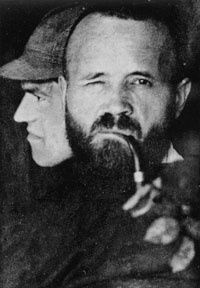
Ludwig MEIDNER. Portrait de Johannes BAADER, 1913


Johannes BAADER (1875-1955)


Le Dadasophe HAUSMANN & l'OBERDADA BAADER, Berlin 1919

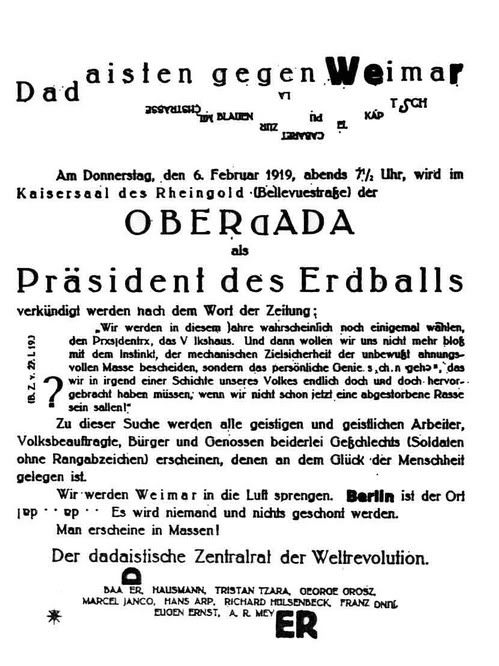
Johannes BAADER. Dadaisten Gegen Weimar, 6 février 1919


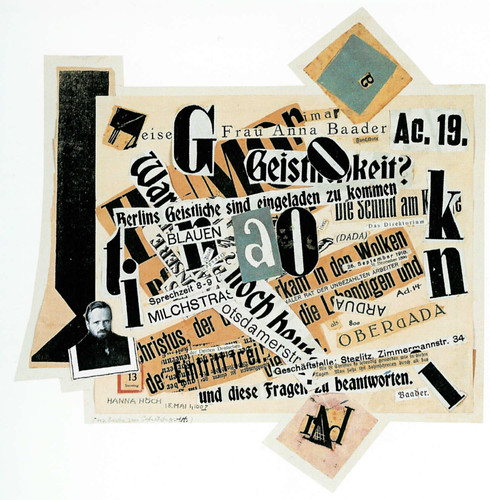
Johannes BAADER. Gutenberggedenkblatt/Ehrenporträt von Charlie Chaplin Dated "Ad 14" (April 14, 1919). Collage, 35 x 46.5, Paris, Collection Musée national d'art moderne, Centre Georges Pompidou


Johannes BAADER. Der Verfasser des Buches Vierzehn Briefe Christi in seinem Heim, 1920, collage, 21,6 X 14,6, New York, The Museum of Modern Art

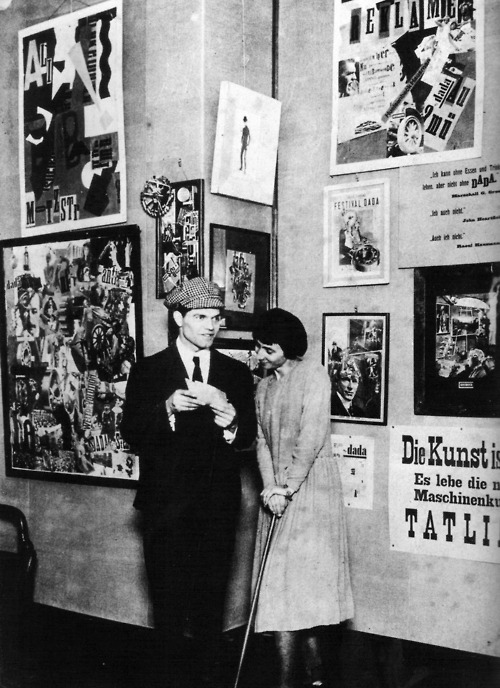
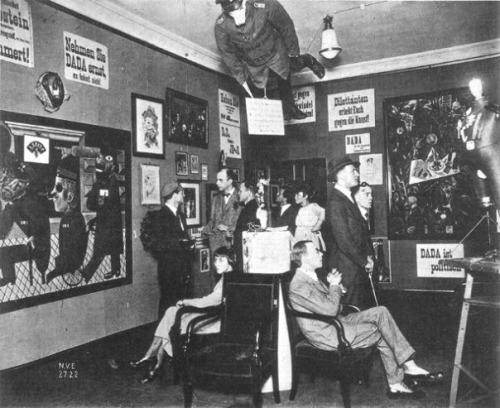
In this photomontage, Baader presents a photograph of a domestic space in which various Dada ephemera hangs on the wall at upper left. A figure has been cut out of the center of the photograph to reveal the image of Baader's dummy exhibited at the Berlin Dada Fair in 1920. This work is, in fact, a sophisticated self-portrait of Baader in his persona as the "Oberdada," a parody of a high-ranking military figure (ex. Oberleutnant) of the Dada "troupes." The figure cut out of the upper photograph can be identified as Baader himself, as his reflection is visible in the mirror at the right edge of the cutout.


Raoul HAUSMANN & Johannes BAADER, Papier à lettres du CLUB DADA, Berlin, 1919


Johannes BAADER, Plasto-Dio-DADA-Drama ; Grandeur et décadence de l'Allemagne, construction-installation, 1920


http://www.lib.uiowa.edu/dada/dadaist%20texts/baader.htm


Men are so necessarily mad that it would only be madness by another name for them to be sane.


- PASCAL, Pensées


Dada is the dancing spirit atop of the world's morals ... Dada is not an axiom ... Dada is a state of mind independent of all schools and theories, one that addresses individuality itself without doing violence to it ... One cannot understand Dada ; one must experience it. Dada is immediate and obvious. If you're alive, you are a Dadaist.


- Richard HUELSENBECK, Dada Almanach


Huelsenbeck’s anti-definition will frustrate those who wish to put Dada into a little box. But Dada does not classify easily. It consciously invites misunderstanding and confusion and it does not have an evident manifesto, though its adherents produced several. Huelsenbeck is right to be abstruse and open with his anti-definition. How could a movement formed by the quiet, reflective Hugo Ball, the Napoleonic Tristan Tzara and the derisively mouthy Huelsenbeck be axiomatic? How could such an orderly movement ever contain someone like the Oberdada ?


The Oberdada was Johannes Baader, or so he claimed.
Who was Baader ?


Walter Mehring, a fellow Dadaist, believed him to be “without doubt the most noble and sublime individual in our midst.” Hans Richter, another friend, said that “he resembled a stick of dynamite blasting itself to pieces. Richard Huelsenbeck disagreed, calling him “a bearded potato-ascetic,” “an architect or tailor’s apprentice or assistant hairdresser, at any rate a bourgeois fool,” and “an unbearable mixture of mendicant friar and petit-bourgeois.”


The German authorities tended to side with Huelsenbeck since they certified him insane. This was excellent news for Baader who found sanity to be rather stigmatic ; unconstrained by the chains of fine mental health, he could do exactly as he chose.


For most of us life is a conciliation between our pleasure-seeking instincts and the voice of Reason. A revolutionary tries to subordinate this authority, this Reason, to the individual will. But for Baader, only the will existed. For all that Huelsenbeck said that he was an egotist, it appears that he didn’t have an ego. He didn’t need to, since for him there was no force that could repress his wildest desires. He probably was indeed psychotic, an idealist caught at the junction of Eros and Thanatos, unsure which route to take. To paraphrase Marx, he was in terror of himself in order to give himself courage. Dada became his perfect outlet.


*


He was born in 1875, in Stuttgart. At the age of 17 he went to study at the city’s trade school, and graduated to the technical college three years later. At 28, he began working as a mortuary architect in Dresden, and at the age of 30 he met Raoul Hausmann, another Dadaist, in Berlin. By 1916 when, in the words of Hans Richter, Dada became “a storm that broke over the world of art as the war did over the nations in the midst of war”, Baader was 40, much the oldest of the Dadaists.


Nevertheless, a chronological approach to Baader’s life is difficult – all the more difficult, since he apparently died twice.


Baader was first pronounced dead on 1 April 1919 from a stroke, aged 43 or so. His comrades at Club Dada prepared an epitaph, and concluded that it was a great shame he wouldn’t be able to make the forthcoming Eighth Zurich Dada Evening. But for many years, Baader had been telling people that he was Jesus Christ (and several other personages besides) – and perhaps he was, for the next day he was reborn. To celebrate this miracle, Baader introduced a new calendar – the Calendar of World Peace. It was not widely adopted. One could claim that Baader did not die from a stroke at all in 1919, and that his subsequent resurrection may not have brought about the calendar of world peace.


One could claim that world peace was inaugurated when Baader first opened Teacher Hagendorf’s Reading Desk that same year. This desk made him his fortune, enabled him to see how silly Socialism and Communism and Nationalism were, and meant that Baader, now quite loaded, was able to bring down world capitalism, which of course brought about world peace. One could claim this – and in fact Baader did, saying afterwards :


The world owes it all to Teacher Hagendorf’s Reading Desk, and also to Oberdada, President of the Globe and Heavenly Sphere, Director of the Last Judgement, True Privy Chairman of the Intertellurian Oberdadaist League of Nations in DADACO.

King of all Dada, Jesus Christ, high-priest of all the world and the universe beyond, arbiter of eternity : it is clear that Baader’s important role in history has been somewhat overlooked. Two more stories about Baader will enlighten us further. The first is very instructive, for it hints at Baader’s power of prophecy (eighty years before Baudrillard, Baader described the first world war as “a newspaper war – in reality, it never existed”).


By 1930, long after Baader first told people he was the Messiah, Germany had becoming full of people claiming to be Christ. One of these characters with a messianic complex became rather powerful in that country soon afterwards. Anyway, a Congress of Christs was organised in Thuringia to determine which one really was the Messiah. Hausmann’s companion Vera Broido-Cohn takes up the story :


The Christs seemed to sprout like mushrooms. A meeting of them was organised in a large meadow near a town, and Baader did a fantastic thing. As he was a journalist, Lufthansa had offered him a pass which enabled him to make whatever trip he wanted, free, if he went to an important rally in Germany. He called the company and asked them if he could be brought to Thuringia and set down in the middle of the meadow. It was accepted.


All of the people at the rally stood up and formed an enormous circle. Each Christ went to the middle, and behind him came all of his supporters. The spectators pushed from behind and then all eyes went up to see Baader descending from the sky. He landed, then went away. They saw his face, and were rendered speechless.


The second story is told by Hausmann in his Courrier Dada. It takes place in Friedenau in 1918, on the 100th birthday of the Swiss novelist Gottfried Keller. Hausmann and Baader were waylaid in the town’s streets, breathing in the tranquil evening sun. Baader had brought a copy of Keller’s Der grune Heinrich along with him and celebrated they read it.


Without wasting a word, we made for the middle of the street and stood under a powerful electric street-light, high – too high – in the air. We took out the tome and began to read, shoulder to shoulder. ‘Poetry, made to measure, on the spot.’ We took turns to open the book at random and read scraps of sentences with no beginning and no end, changing our voices, changing the rhythm and the meaning, leafing backward and forward, spontaneously, without hesitation and without a pause. This gave the whole thing a new meaning and produced some remarkable juxtapositions. We did not notice the passers-by ; we certainly noticed no sign of public interest. Zealously we stuck to our task for at least a quarter of an hour. The words of the book, illuminated by our exalted mode of speech, borne up on the wings of our elation, tormented by new associations, took on a meaning beyond meaning and beyond comprehension.


It was a very good celebration, with all due solemnity, and I am sorry it was not filmed. But talkies did not exist in those days.


What one would give even for a photo. But, a photo or a talkie would have necessitated staging, and this was not a staged event. There was no audience, nothing was on show, and no record of the reading – save Hausmann’s own account – exists. It does not exist as a work of art – nut how much harder it hits you than something framed in a gallery.


Some time after Dada’s heyday, Walter Mehring was in Hamburg, and decided to look up his old friend. “I discovered that he was still around, occasionally tacking up the length of the Binnenalster and sleeping there. But no one, not one sea-dog, nor the hoariest husky in the Hagenbeck Zoo, knew his address.” Many years earlier Baader, as a young architect, had designed part of the Hagenbeck Zoo, in which the animals ran free. He often said he would liked to have designed something similar for humans – only humans are too wild.

awopbopaloobop.blogspot.com/2007/07/oberdada.html

GEORGE GROSZ (II)

George GROSZ. Früh um 5 Uhr (À cinq heure du matin), 1920, Berlin, Galerie Pels-Leusden